
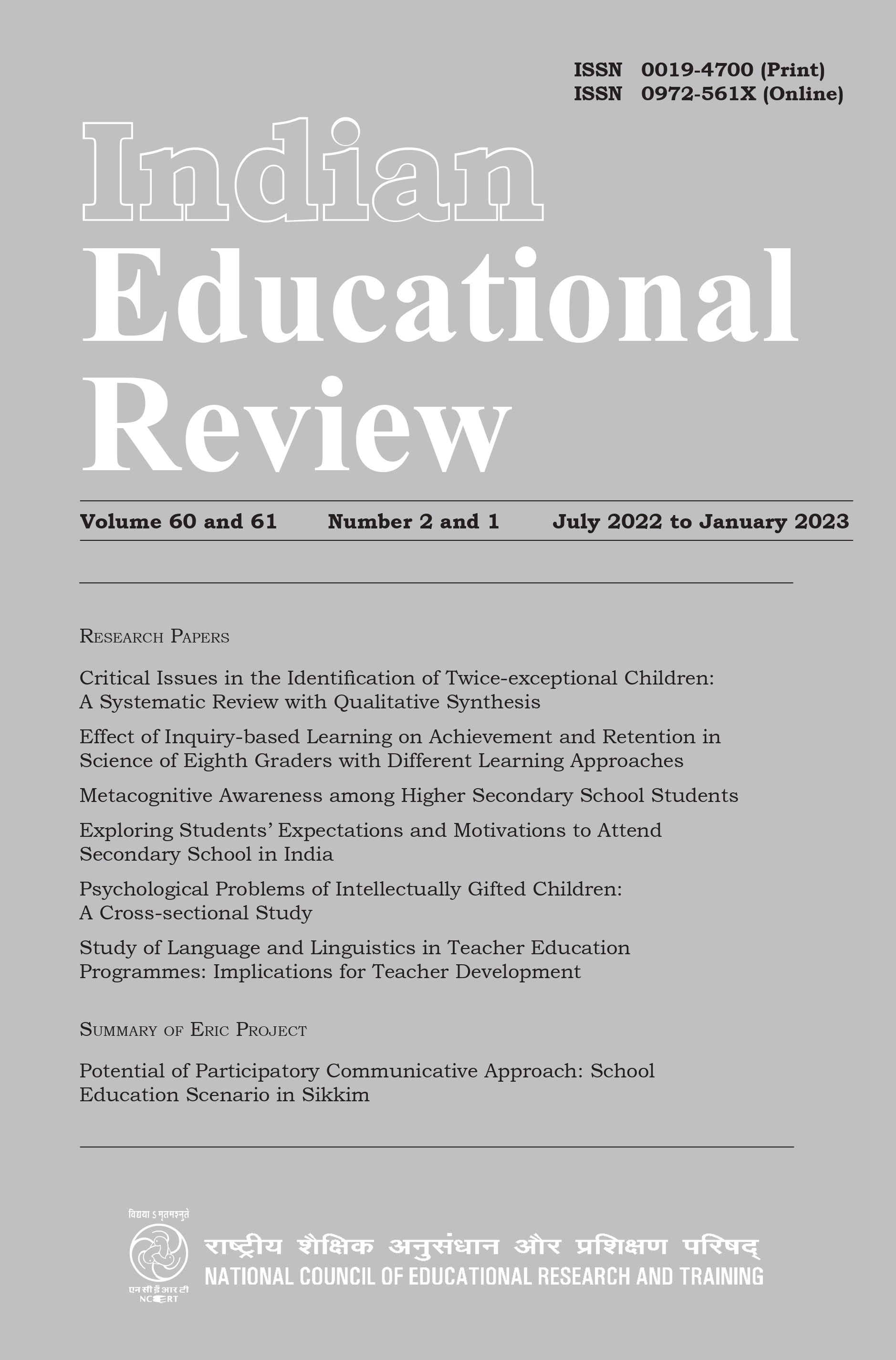
Published 2025-11-20
Keywords
- Metacognitive awareness,
- higher secondary school students,
- metacognition
How to Cite
Abstract
Metacognition is a process of knowing and regulating one’s own cognition. It helps learners to achieve success in their learning. A metacognitively aware learner can better plan and apply his learning strategies. The objectives of the study were to assess the level of metacognitive awareness among higher secondary school students, and to compare their metacognitive awareness in relation to gender and their stream of study. A sample of 86 higher secondary students was selected using simple random technique. An inventory developed by Schraw and Dennison (1994) was used to measure the metacognitive awareness level of students. Descriptive survey method was adopted by the researchers to conduct the study. Researchers employed percentage, t-test and ANOVA to accomplish the objectives of the study. Findings reveals that majority of higher secondary students were found to possess high level metacognitive awareness. It was identified that boys and girls do not differ significantly in their metacognitive awareness. It indicates that gender does not affect the metacognitive awareness. Higher secondary students differ significantly on their metacognitive awareness in reference to their stream of study. Post hoc analysis (Scheffe test) showed that students of Mathematics and Biology were having higher metacognitive awareness than students of Commerce stream. No significant difference was found in between metacognitive awareness of students with Mathematics and Biology. Metacognitive awareness should be encouraged in the classroom to improve learning outcome of the students. Metacognitive awareness of students can be enhanced using innovative learning strategies such as, cooperative learning, reflective learning, and team learning